
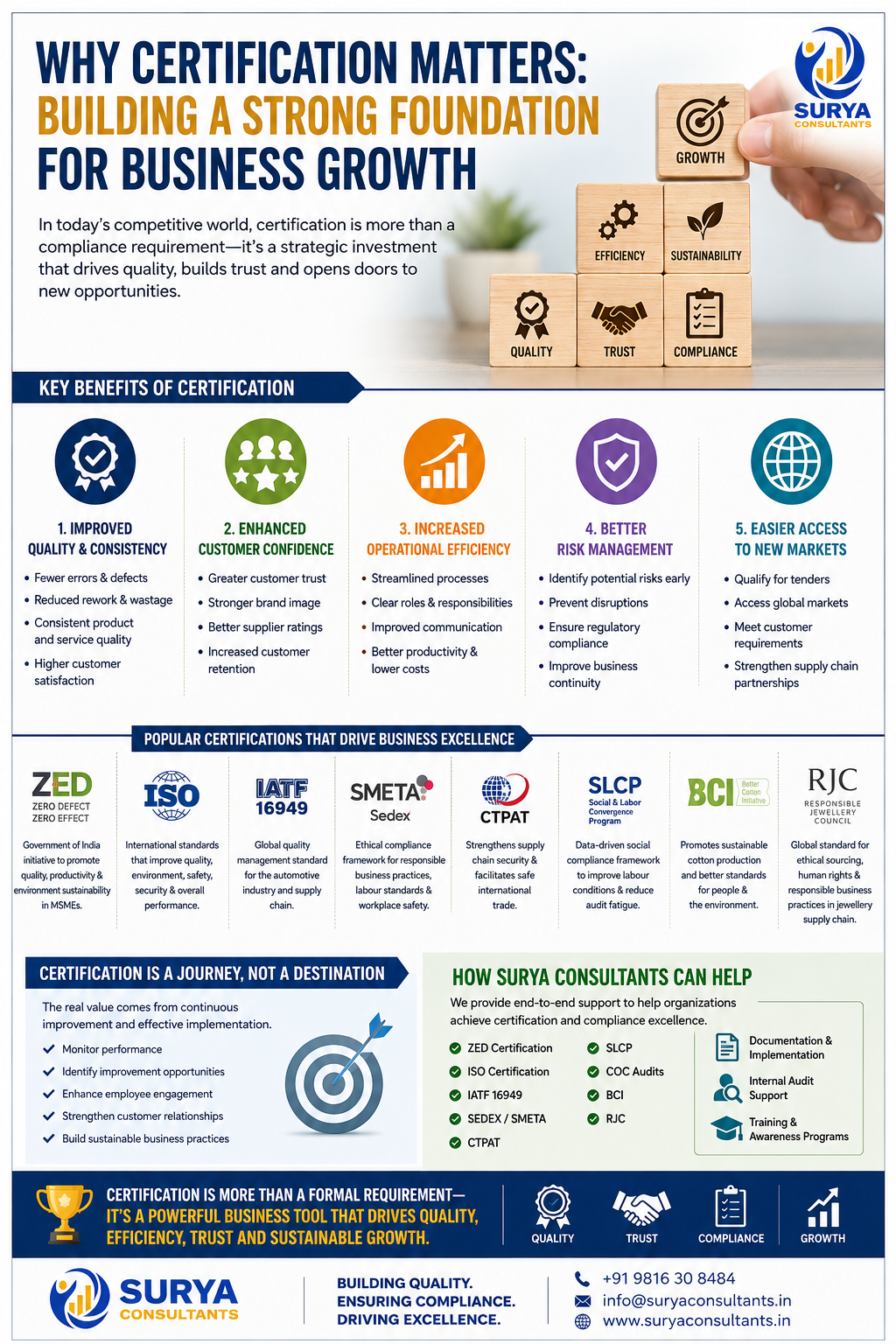
Why Certification Matters: Building a Strong Foundation for Business Growth
In today’s rapidly evolving business environment, organizations face increasing pressure from customers, regulators, and global markets to demonstrate quality, reliability, and responsible business practices. Companies that invest in structured management systems and recognized certifications gain a significant advantage over competitors.
Certification is no longer just a compliance requirement—it is a strategic tool for business growth, operational excellence, and market expansion.
What Is Business Certification?
Business certifications such as ISO, ZED, IATF, SEDEX/SMETA, CTPAT, SLCP, BCI, and RJC provide frameworks that help organizations establish effective management systems, improve performance, and meet international standards.
These certifications demonstrate that a company is committed to quality, customer satisfaction, sustainability, and continuous improvement.
Benefits of Certification for Businesses
1. Improved Quality and Consistency
One of the primary benefits of certification is the establishment of standardized processes. When procedures are clearly defined and consistently followed, organizations experience:
- Fewer errors and defects
- Reduced rework and wastage
- Better product and service quality
- Increased customer satisfaction
Consistent quality helps businesses build a strong reputation and maintain long-term customer relationships.
2. Enhanced Customer Confidence
Customers prefer working with organizations that can demonstrate their commitment to quality and compliance.
Certified organizations often enjoy:
- Greater customer trust
- Improved brand image
- Better supplier ratings
- Increased customer retention
Certification acts as independent verification that an organization follows internationally accepted practices.
3. Increased Operational Efficiency
Many organizations struggle with inefficient processes, duplicated work, and resource wastage.
Certification frameworks help businesses:
- Streamline workflows
- Define responsibilities clearly
- Improve communication
- Monitor performance effectively
The result is improved productivity and reduced operational costs.
4. Better Risk Management
Every business faces risks related to quality, safety, security, environment, and compliance.
Modern certification systems emphasize risk-based thinking, enabling organizations to:
- Identify potential risks early
- Implement preventive measures
- Improve business continuity
- Reduce disruptions
Proactive risk management contributes to long-term stability and growth.
5. Easier Access to New Markets
Many customers, government agencies, and multinational corporations require suppliers to maintain recognized certifications.
Certification can help organizations:
- Qualify for tenders
- Access international markets
- Meet customer requirements
- Strengthen supply chain partnerships
For many businesses, certification becomes a gateway to larger opportunities and higher-value contracts.
Popular Certifications That Drive Business Excellence
ZED (Zero Defect Zero Effect)
A Government of India initiative designed to help MSMEs improve quality, productivity, and environmental performance while gaining access to incentives and support programs.
ISO Standards
Internationally recognized standards that help organizations improve quality, environmental performance, information security, occupational health and safety, energy management, and more.
IATF 16949
A global quality management standard specifically designed for the automotive industry and its supply chain.
SEDEX / SMETA
Widely accepted ethical compliance frameworks that demonstrate responsible labor practices, health and safety compliance, and ethical business operations.
CTPAT
A supply chain security program that helps organizations strengthen security measures and facilitate international trade.
SLCP
A data-driven social compliance framework that reduces audit duplication and improves labor transparency.
BCI (Better Cotton Initiative)
A sustainability program promoting responsible cotton production and environmental stewardship.
RJC (Responsible Jewellery Council)
A global standard for ethical sourcing and responsible business practices in the jewelry and precious metals industry.
Certification Is a Journey, Not a Destination
Many organizations view certification as a one-time achievement. However, the true value lies in continuous improvement.
Successful organizations use certification frameworks to:
- Monitor performance
- Identify improvement opportunities
- Enhance employee engagement
- Strengthen customer relationships
- Build sustainable business practices
The certificate is only the beginning—the real benefits come from consistent implementation and ongoing improvement.
How Surya Consultants Can Help
At Surya Consultants, we specialize in helping organizations achieve certification and compliance excellence through practical, result-oriented solutions.
Our services include:
- ZED Certification
- ISO Certification
- IATF 16949
- SEDEX / SMETA
- CTPAT
- SLCP
- COC Audits
- BCI
- RJC
- Documentation & Implementation
- Internal Audit Support
- Training & Awareness Programs
Our experienced consultants provide end-to-end support, ensuring a smooth certification journey and sustainable business improvement.
Conclusion
Certification is more than a formal requirement—it is a powerful business tool that drives quality, efficiency, customer trust, and growth. Organizations that invest in strong management systems are better prepared to compete, innovate, and succeed in today’s global marketplace.
Whether you are an MSME seeking ZED certification or an exporter aiming for international compliance, the right certification strategy can unlock new opportunities and strengthen your competitive advantage.
Ready to take your business to the next level? Partner with Surya Consultants and build a foundation for sustainable growth and excellence.